
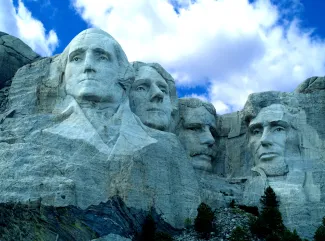
There's something deeply compelling about secrets hidden in plain sight. As I stood at the base of Mount Rushmore during my first family visit years ago, watching my daughter trace the massive presidential profiles with her finger against the horizon, I had no idea that behind Abraham Lincoln's granite head lay a chamber that would have fascinated her science-loving mind even more than the monument itself. Nearly three million people visit Mount Rushmore annually, according to the National Park Service. They photograph the faces, walk the Presidential Trail, visit the sculptor's studio. Yet most leave without knowing that concealed within the mountain lies an unfinished chamber called the Hall of Records — a real granite vault that isn't visible from any viewing platform and remains inaccessible to the public. This isn't folklore or Hollywood embellishment. The Hall of Records is an actual room blasted into the rock face, a tangible remnant of sculptor Gutzon Borglum's far more ambitious vision for America's most iconic mountainside monument.
The Sculptor's Grand Design
When Borglum began carving Mount Rushmore, he envisioned something beyond four presidential faces. His original plans called for a grand hall measuring 80 feet tall by 100 feet long, accessible via an 800-foot granite staircase, according to historical records. This wasn't meant to be a tourist attraction in the conventional sense — it was designed as a repository, a time capsule for future civilizations who might stumble upon these massive stone faces and wonder about their origins. The concept speaks to both Borglum's artistic ambition and his understanding of temporal humility. He recognized that civilizations forget their predecessors, that even the most monumental works can become mysteries without context. Stonehenge stands as testament to that truth. From a family travel perspective, I find this narrative element particularly valuable. When we return to destinations with our children as they grow, the stories behind the landmarks often prove more captivating than the landmarks themselves. The Hall of Records transforms Mount Rushmore from a static photo opportunity into a tangible example of how vision evolves, how practicality intersects with idealism, and how even unfinished dreams leave their mark.
What Actually Got Built
Work on the Hall of Records began in 1938, when workers blasted a 70-foot-long cavern using dynamite. But the government funding that made Mount Rushmore possible was finite, and priorities shifted. The chamber was never completed according to Borglum's original specifications. No grand staircase was carved. No elaborate entrance hall was finished. The Hall of Records exists as a rough-hewn tunnel behind Lincoln's head — functional but far from the architectural vision Borglum sketched. For travelers planning visits, this context matters. Mount Rushmore presents itself as a completed monument, which it is in terms of the presidential faces. But understanding what remains unfinished adds dimension to the experience, particularly for families with older children or teenagers who appreciate complexity over simple spectacle.
Why the Public Cannot Visit
The Hall of Records is not accessible to tourists for straightforward reasons: safety and preservation. The chamber sits near cliff edges with no safe public access route. There's no infrastructure supporting visitor traffic — no lighting systems, no guardrails, no emergency protocols that would meet modern safety standards for a site welcoming nearly three million people annually. This inaccessibility frustrates some visitors, but as someone who has navigated family travel logistics across dozens of destinations, I understand the National Park Service's position. The risk management alone would be prohibitive. More importantly, opening the Hall of Records to regular tourism would fundamentally alter its purpose. The chamber was designed as a message to distant future generations, not contemporary visitors. There's something philosophically appropriate about maintaining that original intent, even if it means most of us will never stand inside it.
What the Hall of Records Contains
Though unfinished as an architectural space, the Hall of Records eventually fulfilled at least part of Borglum's vision. In 1998, sixteen porcelain enamel panels were placed inside a teakwood box, sealed within a titanium vault, and lowered into the chamber floor. These panels contain the text of foundational American documents, biographical information about the sculpted presidents, and the history of the monument's construction. The vault is covered by a granite capstone weighing 1,200 pounds. This isn't a display meant for selfies or interactive exhibits. It's a repository — perhaps the most exclusive archive in American tourism, viewable by essentially no one, intended for civilizations that may or may not ever discover it. From a family education standpoint, I've found that children grasp this concept more readily than we might expect. The idea that something valuable exists not for our use but for unknown future observers touches on themes of legacy, stewardship, and long-term thinking that resonate across ages.
Planning Your Mount Rushmore Visit
While you cannot tour the Hall of Records, Mount Rushmore offers substantial experiences for families and luxury travelers seeking meaningful cultural engagement. The Presidential Trail provides the closest access to the carved faces, winding beneath the monument through pine forests that smell of vanilla bark in summer heat. The Sculptor's Studio, open seasonally, offers ranger-led programs that explain Borglum's techniques and vision — including discussions of the unfinished Hall of Records. For families with children interested in engineering, geology, or American history, these programs provide context that transforms the visit from passive viewing to active learning. South Dakota's Black Hills region surrounding Mount Rushmore supports a range of accommodations, from rustic lodges to more refined properties in Rapid City. The monument itself draws visitors year-round, though summer crowds peak substantially. Shoulder season visits in May or September offer comfortable weather with reduced congestion — particularly valuable for families with young children who struggle with long waits and packed viewpoints. The Hall of Records may remain hidden behind Lincoln's granite face, inaccessible and largely unknown to the millions who photograph the monument each year. But knowing it exists there — a purposeful secret, an unfinished dream, a message sealed for future centuries — adds a layer of intrigue that no visible attraction could match. Some of the best travel experiences, I've learned, are the ones we can't actually touch. They're the stories that make us reconsider what we're looking at, the hidden contexts that transform familiar landmarks into something more complex and more human. Mount Rushmore's secret chamber does exactly that.
About the Author

Jennifer Wilmington
Jennifer Wilmington is a distinctive voice in the world of family and luxury travel, offering unique perspectives derived from her diverse background and experiences.