
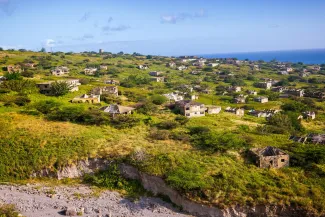
PLYMOUTH, Montserrat — In 1995, a once-functioning Caribbean capital became uninhabitable in minutes. Today, it sits frozen under volcanic ash, a warning and a spectacle in equal measure.
Montserrat, a British Overseas Territory and mountainous island in the Caribbean, lost its capital city Plymouth when the Soufrière Hills volcano erupted with catastrophic force. The initial eruption in 1995 choked the sky almost completely black and forced a full evacuation. By December, 4,000 people, the entire population of Plymouth, had been relocated, according to Travel.
What followed was not a gradual recovery but a second, deadlier blow. In June 1997, another massive eruption killed 19 people and sent pyroclastic flows racing through the city, incinerating buildings and infrastructure across the island. Plymouth never recovered. The city now lies buried under 1.4 meters (4.6 feet) of ash, earning it the grim moniker "the Pompeii of the Caribbean."
A Capital Abandoned, Not by Choice
The collapse of Plymouth was swift and total. Residents returned briefly after the 1995 evacuation, attempting to salvage what remained of their homes and livelihoods. That hope ended in 1997. The second eruption made it clear: the volcano was not finished, and Plymouth was no longer safe for human habitation. The ash didn't just cover the city. It entombed it. Roofs collapsed under the weight. Streets disappeared. The administrative heart of Montserrat, along with its port and much of its economy, vanished beneath gray powder. The British government and local authorities made the decision permanent. Plymouth was declared an exclusion zone, and the island's government relocated north.From Tragedy to Dark Tourism Destination
Now, decades after the eruptions, Plymouth has become a destination for travelers drawn to disaster sites and the visual drama of abandonment. The phenomenon is known as dark tourism, and Montserrat fits the profile: a place defined by catastrophe, accessible only under controlled conditions, and frozen in time. Visitors can approach the exclusion zone with guides and view the remains of the city from designated overlooks. What they see is surreal. Church steeples protrude from ash drifts. Building facades, stripped of paint and purpose, lean against buried foundations. The landscape is monochrome, hostile, and oddly magnetic. This is not a sanitized tourist experience. The ash is real. The danger is real. The volcano remains active, and the exclusion zone exists for a reason. Guides enforce strict boundaries. Photography is permitted, but lingering is not.Montserrat's Long History and Sudden Reversal
Christopher Columbus first discovered Montserrat in 1493 during his second trip to the Americas, though he didn't dock his ship, according to Travel. The island became a British colony in the 17th century and developed a small but stable economy based on agriculture and trade. Plymouth served as the administrative and commercial center for centuries. The 1995 eruption shattered that stability. The island's population plummeted as residents fled to neighboring islands, the United Kingdom, and beyond. Infrastructure collapsed. Tourism, once a modest income source, evaporated. What remained was a territory in crisis, dependent on aid and uncertain of its future. The volcano continues to shape that future. Soufrière Hills has remained intermittently active since the 1990s, with ongoing seismic monitoring and periodic eruptions that remind residents and visitors alike that the threat has not passed.Practical Realities for Travelers
Reaching Montserrat requires commitment. The island has no commercial airport capable of handling large jets. Travelers typically fly into Antigua and take a short regional flight or ferry to Montserrat. Accommodations are limited, concentrated in the northern safe zone far from the exclusion area. Tours to the Plymouth overlook are available through local operators and typically include stops at the Montserrat Volcano Observatory, where scientists track the mountain's activity in real time. The observatory offers context that raw visuals cannot: seismograph readings, eruption histories, and projections of future risk. This is not a place for casual sightseers. The island's infrastructure remains fragile. Power outages are not uncommon. Medical facilities are basic. Cell service can be spotty outside the main settlements. Travelers accustomed to polished Caribbean resorts will find Montserrat jarringly different.What Dark Tourism Reveals
Dark tourism is not new, but its appeal has grown. Sites like Chernobyl, Pompeii, and now Plymouth attract visitors who seek something beyond leisure: a confrontation with disaster, loss, and the limits of human control. Montserrat offers that confrontation without theatrics. The island does not market itself as a theme park of tragedy. It simply exists, scarred and functional, moving forward while its former capital remains locked in 1997. For photographers, the visual power of Plymouth is undeniable. The textures of ash, the geometry of half-buried structures, the contrast between verdant hillsides and gray devastation create compelling, haunting images. For travelers interested in geopolitics and disaster response, Montserrat provides a case study in resilience, relocation, and the long-term consequences of living near active volcanoes. The island's population has stabilized at a fraction of pre-eruption levels. New settlements have been built in safer zones. Life continues, but it is fundamentally shaped by the reality that the volcano is not dormant. It is simply resting. Plymouth remains a ghost town, buried and silent. It will not be rebuilt. It will not be reclaimed. It stands as both memorial and warning, a place where nature reasserted its authority and left no room for negotiation.About the Author

Jeff Colhoun
Jeff Colhoun is an acclaimed travel writer, photographer, and filmmaker, whose work is respected both in the United States and internationally.