
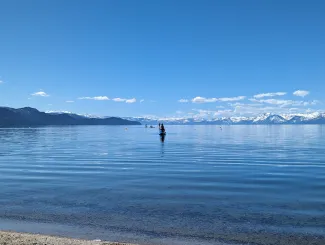
Historic Livestream Dive Will Plumb Lake Tahoe’s Depths and Legends
SOUTH LAKE TAHOE, Calif. — Lake Tahoe is about to give up some of its deepest secrets. For the first time in history, a remotely operated vehicle (ROV) will dive to the bottom of Lake Tahoe and broadcast the journey live to the world. The event, taking place today (Friday, Sept. 5, 2025), promises to combine cutting-edge exploration technology with scientific insight – and maybe even put a few local legends to rest.
A Journey to Tahoe’s Bottom, Live for All
The Tahoe Fund, in partnership with the Restoring the Lake Depths Foundation, is leading this first-ever live-streamed descent into Tahoe’s abyss. Beginning at 9:30 a.m. Pacific Time, viewers can follow along on the Tahoe Fund’s website as the custom-built ROV – nicknamed “Deep Emerald” – ventures 1,570 feet down, near the lake’s maximum depth. “Few people have had the opportunity to explore what’s under the surface of Lake Tahoe, the second deepest lake in the U.S.,” said Amy Berry, CEO of Tahoe Fund, noting that this project will let everyone experience the lake in a whole new way.
As the ROV descends through the inky waters, experts on board will narrate the voyage in real time. Tim Crandle, president of SeaView Systems (the ROV’s designer), will explain the state-of-the-art technology making this dive possible, while Dr. Sudeep Chandra, a limnology professor at the University of Nevada, Reno, will chime in to unpack the secrets behind Tahoe’s famed water clarity. Organizers say the goal is not only to thrill viewers but also to highlight the science and conservation efforts that keep this alpine lake healthy. “The Lake Tahoe watershed is recognized nationally and globally as a resource of special significance,” Chandra notes, and this dive underscores ongoing efforts to pristine.
Cutting-Edge Tech: Meet Deep Emerald
The “Deep Emerald” ROV, funded by Tahoe Fund and Martis Camp Foundation, is lowered into Lake Tahoe for a test dive. Equipped with eight thrusters, LED lights, and a 4K low-light camera, it can reach the lake’s deepest points.
Making this historic plunge possible is the custom ROV dubbed Deep Emerald, a marvel of modern engineering. Built by the Restoring the Lake Depths Foundation with open-source components from Blue Robotics and software by Mission Robotics, Deep Emerald is purpose-designed for extreme underwater exploration. The unit boasts eight thrusters for agile maneuvering, four high-powered LED lamps to pierce the darkness, and a 4K Ultra HD camera optimized for low light – ensuring crystal-clear views in near-total darkness
A 600-meter (1,968-foot) fiber-optic tether links the ROV to its surface operators, transmitting live video and data from depths few devices can reach. “Deep Emerald is our flagship ROV… built for advanced underwater exploration,” said Lindsay Kopf, founder and executive director of the Restoring the Lake Depths Foundation. “Its 600m fiber optic tether allows for deep-water exploration, making it a rare ROV capable of reaching the depths of Lake Tahoe’s deepest points.” In testing, Deep Emerald has already proven its worth by helping remove litter from the lakebed and identify aquatic invasive species threatening Tahoe.
The livestream will utilize a split-screen feed – one view from Deep Emerald’s onboard camera and another from the support vessel at the surface. This setup, enabled by satellite uplink and streaming technology, means viewers will simultaneously see what the robot sees underwater and the action on the boat as the team pilots the dive. The public can even submit questions via email ([email protected]) for the experts to answer during the broadcast, making it an interactive exploration for everyone watching.
Peering Into an Alpine Abyss
Lake Tahoe’s extreme depth has long been a source of fascination. At 1,645 feet (501 meters) at its deepest, Tahoe is the second-deepest lake in the United States, trailing only Oregon’s Crater Lake For comparison, if the Empire State Building were submerged in Tahoe, its tip would still be over 200 feet below the lake’s surface. Until now, however, Tahoe’s deepest reaches have never been seen live. Scientists have mapped the lakebed with sonar and taken some remote videos, but no human or camera has ever continuously explored the bottom in real time.
The challenges are considerable: near-freezing water (around 39°F at depth), total darkness, and pressure over 40 times that at the surface. Traditional SCUBA divers are limited to a few hundred feet at most, and even specialized mixed-gas divers who explored the famous wreck of the SS Tahoe (a steamship scuttled in 1940) only reached about 500 feet deep. Deep Emerald’s dive to 1,570 feet will venture far beyond the reach of any prior human exploration in Tahoe. “We were told there wasn’t going to be much life at the bottom of Lake Tahoe, but it’s hard to get a camera shot without something alive in the video – shrimp, fish, large fish,” observes Chase Petley, an independent researcher who has been probing Tahoe’s depths with his own DIY rover. Indeed, contrary to the notion that nothing can survive in the lake’s cold abyss, previous submersible probes have spotted tiny shrimp and fish even at great depths.
Scientists are eager to see what Deep Emerald might discover. Tahoe’s geology is complex – the lake sits in a massive fault-formed basin (or graben) between the Sierra Nevada and Carson ranges. Over millennia, earthquakes and landslides have shaped the underwater terrain, carving steep drop-offs and depositing mysterious boulder fields. Some researchers speculate there may even be deeper crevices in the lakebed than official maps show. Petley, for instance, believes a massive underwater crevasse between fault lines hints that Tahoe “could be much deeper” in spots than the commonly cited 1,600-foot depth. The ROV’s journey might help clarify such questions by providing high-resolution visual confirmation of Tahoe’s true bottom features.
Legends and Lore from the Lakebed
Beyond science, Lake Tahoe’s depths have fueled myths and legends for generations – tales that today’s dive could help illuminate. Locals have long whispered about what might lie beneath “Big Blue”, ranging from the plausible to the fantastical. The most famous legend is “Tahoe Tessie,” a Loch Ness–style lake monster said to inhabit these waters. Since the early 1900s, boaters have reported sightings of a large, serpentine creature, and even the native Washoe and Paiute tribes spoke of a powerful serpent in Tahoe’s waters. While no scientific evidence of Tessie exists, the folklore adds an extra thrill whenever the lake’s dark depths are probed.
Even more chilling are the rumors of preserved bodies resting in Tahoe’s depths. During the mid-20th century, when organized crime thrived at Tahoe’s casinos, it was whispered that mob hitmen disposed of victims in the lake’s infinite darkness. According to legend, the extreme cold and depth prevent typical decay, so the corpses never resurface – creating an underwater time capsule of fully clothed bodies from the 1920s to 1940s. Fishermen swapping stories have even claimed to have snagged gruesome souvenirs on their lines (a severed human ear in one telling, a partial hand in another), fueling what’s known as the legend of “Three-Fingered Tony”. One particularly deep spot off South Shore is ominously nicknamed “The Grave” for the supposed multitude of mob remains suspended there like an eerie underwater wax museum. It’s a ghastly tale – and one that today’s mission might finally put to the test, as the ROV’s unblinking eye scans the sediment for any evidence of these long-rumored relics.
Perhaps the most oft-repeated story is that Jacques Cousteau himself once dived in Lake Tahoe and came back spooked. In the lore, the famed ocean explorer emerged from a secret 1970s dive pale and shaken, allegedly uttering: “The world isn’t ready for what’s down there.” Some versions claim Cousteau encountered a trove of preserved human bodies in Victorian garb, frozen in time. In reality, there is no record that Cousteau ever visited Lake Tahoe at all, and experts dismiss this as pure myth. “While the unusually cold temperatures can slow the decay of bodies, it is unlikely that any have been preserved,” a local historian notes, debunking the Cousteau tale. Still, the mystique of Cousteau’s supposed pronouncement has become part of Tahoe’s allure – and only adds to the anticipation surrounding this live dive.
Tahoe’s depths hold other curious lore as well. One enduring myth posits a subterranean tunnel connecting Lake Tahoe to Pyramid Lake, a desert lake 60 miles away in Nevada. This was sometimes offered to explain why the occasional Tahoe drowning victim purportedly “vanished” only to be found in Pyramid Lake – though geologists say no such tunnel exists (the story likely arose from early 1900s water-diversion schemes that were never built). Another colorful yarn involves eccentric 1930s millionaire George Whittell, who kept exotic pets at Tahoe’s Thunderbird Lodge. Whittell’s personal airplane, the legend goes, crashed into the lake with his pet elephant on board – leaving a perfectly preserved pachyderm at the bottom of Tahoe. Historians chuckle at this fanciful tale: Whittell did own a lion and other animals, but never an elephant on a plane, and no record of such a crash exists.
While these stories stretch credulity, they demonstrate the aura of mystery that has long surrounded Tahoe’s profound depths. “Despite the efforts and research of many, little truth has been found to these myths,” writes the Tahoe Daily Tribune, noting that Tahoe’s history and cultural diversity have bred a rich tapestry of folklore. Today’s expedition won’t likely surface any sea monsters or ghostly mobsters – but it will give the public an unprecedented look into the dark, hidden world that inspired those legends.
A New Chapter in Tahoe Exploration
The livestreamed dive marks a milestone in Lake Tahoe’s exploration story. For decades, our understanding of the lake’s deepest realms has been limited. Researchers from UC Davis and others have monitored Tahoe’s water quality and clarity for years, lowering instruments and sampling the depths, but continuous video exploration remained unfulfilled. Occasional high-tech forays have offered glimpses: in 2012, for example, a team of engineers used small open-source robots to survey the sunken SS Tahoe steamer, proving that DIY submersibles could venture where divers cannot. More recently, hobbyist explorers like Chase Petley have devoted years to building their own rovers, capturing photos and footage from the bottom of Tahoe as part of a personal quest to “find out what’s at the bottom of Lake Tahoe”. Petley’s discoveries of abundant deep-water life helped spark public interest, as evidenced by tens of thousands following his Mysteries of the Deep project on social media.
Now, with Deep Emerald’s dive, a broad audience can join in the adventure. The ROV’s live feed will allow scientists, locals, and curious viewers around the globe to experience Lake Tahoe’s undersea world in real time – something that until now was the stuff of imagination. The mission is more than just a technological feat; it’s also a celebration of Tahoe itself. “In a way, we’re all explorers today,” said one organizer, inviting the public to share in the sense of discovery. As the ROV descends past the reach of sunlight into water as clear as it is cold, who knows what will come into view? Perhaps ancient trees drowned by a long-ago landslide, or strange geologic formations carved by ice age currents. Maybe nothing but silt, rocks, and the occasional trout or crawfish skittering out of the lights – or, just maybe, something truly unexpected.
How to Watch and What’s Next
The live broadcast begins at 9:30 a.m. PT on Sept. 5, 2025, accessible via the Tahoe Fund’s official website. Viewers can tune in from anywhere to follow the descent into Tahoe’s emerald depths. During the stream, audience questions submitted to the Tahoe Fund’s team (at [email protected]) will be relayed to the experts on the boat for answering in real time. The entire dive is expected to take a few hours, including time to reach the bottom, explore, and safely return the ROV to the surface.
Local officials and environmental groups are hopeful that the excitement generated by this event will translate into greater support for lake conservation. Lake Tahoe faces ongoing challenges – from warming waters and algae growth reducing its famed clarity, to invasive species and pollution. By showcasing Tahoe’s hidden underwater beauty and scientific value, the Tahoe Fund and its partners aim to inspire the public to help protect this natural treasure. “If we can’t fix it here, then we can’t fix it anywhere,” says Heather Segale of the Tahoe Environmental Research Center, emphasizing Tahoe as a bellwether for freshwater conservation.
As the world watches the depths of Lake Tahoe come into view today, one thing is certain: this is a journey into the unknown that has been a long time coming. Whether it confirms old legends or simply reveals a serene, silent landscape, this pioneering live dive is making history in one of North America’s most iconic lakes. And for the first time, everyone gets a front-row seat to experience the wonder beneath Tahoe’s waves.
About the Author

Bob Vidra
Bob Vidra, based in scenic Tahoe, is an esteemed tech editor known for his deep understanding of the dynamic intersection of technology, travel, and the outdoors.