
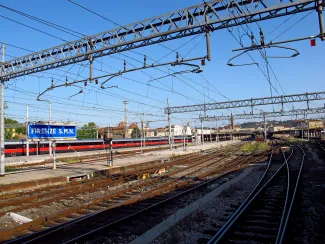
FLORENCE, Italy — If you're traveling through Florence tonight, you might want to check your train status. All high-speed and intercity rail traffic came to a complete halt at 18:30 (6:30 p.m.) after someone was struck by a train near the Florence Rifredi station, according to Ansa. It's the kind of incident that ripples through Italy's entire rail network; Florence sits at a crucial junction for trains running between Milan, Rome, and beyond. And right now, that junction is completely shut down while authorities conduct their investigation.
What's Happening at Florence's Rail Hub
The suspension affects the entire Florence rail node, which means we're not talking about a single track or platform. This is a full-stop situation while judicial authorities carry out their required investigation, according to Ansa. Trenitalia reported that approximately ten high-speed (Alta Velocità) and Intercity trains are directly involved and currently stopped. That's ten trains full of passengers sitting stationary, waiting for the all-clear. But here's where it gets messier for travelers: the impact doesn't stop with those ten trains. Additional high-speed and intercity services are expected to experience delays as the backlog builds. Regional trains aren't escaping either; they may face route limitations and cancellations as operators work around the closure.
The Ripple Effect Across Italy's Network
Florence isn't just another stop on Italy's rail map. It's a critical connection point where north-south routes converge. When Florence stops, the effects radiate outward. A train delayed leaving Florence for Rome creates knock-on delays in Rome. A Milan-bound service stuck in Florence throws off connections further north. If you've ever traveled Italy's high-speed network, you know how tightly coordinated the schedules are. Trains share tracks, platforms, and crews. One significant disruption can create a domino effect that takes hours to untangle, even after service resumes.
What Travelers Should Do
First things first: don't just show up at the station hoping for the best. Check your train status before you leave. Trenitalia's app and website should have updated information, though during major disruptions, the details can lag behind real-time conditions. If your train is canceled or significantly delayed, you have options. Trenitalia typically allows passengers to rebook on alternative services without penalty during major disruptions like this. You can also request a refund if you choose not to travel. But here's the reality: with this many trains affected, rebooking might not get you moving much faster. Alternative services will fill up quickly as stranded passengers scramble for seats. If your journey isn't time-critical, waiting until tomorrow might be the less stressful option. For those connecting through Florence to other destinations, the complications multiply. A missed connection in Rome or Milan because your Florence train never arrived creates its own set of rebooking headaches. Give yourself breathing room if you're making onward connections tonight or tomorrow morning.
When Will Service Resume?
That's the question everyone's asking, and honestly, there's no clear answer yet. The timeline depends entirely on how long the judicial investigation takes. These investigations can't be rushed; authorities need to complete their work thoroughly. What we do know is that Trenitalia is monitoring the situation, according to Ansa. Once authorities give the all-clear, it won't be an instant return to normal operations. Trains need to be repositioned, crews need to be where they're supposed to be, and the carefully choreographed schedule needs to be rebuilt. Best case? Service resumes later this evening with delays continuing into the night. Worst case? Disruptions stretch into Sunday morning as the network slowly returns to normal operations.
The Broader Context
Incidents like this are tragic reminders that rail networks, for all their efficiency and speed, operate in the real world where unpredictable events happen. Italy's high-speed network moves millions of passengers each year with remarkable safety and reliability. But when something does go wrong, the interconnected nature of the system means one incident affects thousands of travelers. For anyone traveling through Florence in the coming hours, patience will be your most valuable asset. Check your status frequently, have backup plans ready, and remember that the crews working to sort this out are dealing with an extraordinarily complex situation. Safe travels, and give yourself extra time if you're moving through Florence anytime soon.
About the Author

Bob Vidra
Bob Vidra, based in scenic Tahoe, is an esteemed tech editor known for his deep understanding of the dynamic intersection of technology, travel, and the outdoors.