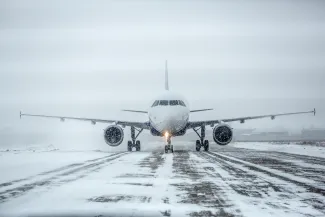
Storm Timing Compounds Peak Travel Volume
PHILADELPHIA, Pennsylvania — A winter storm bearing down on the Philadelphia region Friday afternoon is driving a surge of travelers through Philadelphia International Airport on what was already forecast to be the busiest travel day of the holiday season. The convergence of weather-related urgency and peak seasonal demand is creating compounded pressure across terminals as passengers scramble to depart ahead of deteriorating conditions.
The storm, expected to arrive Friday afternoon and continue into evening, has forced travelers to compress their departure schedules into a narrower window than originally planned. That compression comes at the worst possible time. Even without weather complications, this Friday was projected to see the highest passenger volumes of the entire holiday period at PHL, according to Travel.
This is textbook risk convergence: two independent pressure systems colliding to create something worse than either would produce alone. Airlines and airport operations were already stretched to capacity handling holiday volumes. Now add thousands of travelers attempting to move flights earlier, rebook connections, or simply get through security and to gates faster than planned. The result is predictable strain across every operational touchpoint.
What Travelers at PHL Are Facing
For anyone still on the ground at Philadelphia International Friday, the calculus is straightforward: get out now or accept delay. Winter storms in the Mid-Atlantic rarely arrive on schedule or behave predictably. Forecasts can shift. Precipitation types can change. What begins as rain can transition to freezing rain or snow, grounding departures for hours.
The urgency isn't just about flight cancellations. It's about airport access. Ground transportation deteriorates rapidly once ice or heavy snow begins. Travelers attempting to reach PHL during active winter weather face hazardous road conditions, slower traffic, and increased accident risk. Missing a departure window because you couldn't safely reach the airport is a scenario that plays out repeatedly during these events.
Inside the terminals, the operational reality is staffing and gate availability. Airlines can only turn aircraft and process passengers as quickly as crew, equipment, and infrastructure allow. When everyone tries to leave at once, bottlenecks form. Security lines extend. Gate hold areas fill beyond comfortable capacity. Delays cascade.
Storm Arrival Window Creates Hard Deadline
The Friday afternoon and evening arrival window for this storm system effectively creates a hard deadline for departures. Any flight scheduled to push back during or after storm onset faces elevated risk of delay or cancellation. De-icing operations slow turnarounds. Reduced visibility affects taxi and takeoff clearances. Accumulation on taxiways and runways requires plowing, further limiting movement.
Airlines operating at PHL are almost certainly implementing proactive scheduling adjustments, though the extent varies by carrier. Some may preemptively cancel flights scheduled during the storm's peak impact window to avoid stranding aircraft and crew out of position. Others will attempt to operate as long as conditions permit, banking on marginal weather holding just long enough to push metal.
For travelers, this means monitoring flight status obsessively. Airlines will not wait for passengers who are stuck in security or delayed reaching the airport. If your flight boards early because the airline sees a narrow operational window before conditions worsen, you either make that window or you're rebooked.
Broader Holiday Travel Pressure
This Friday's status as the busiest travel day of the holiday season reflects predictable post-Christmas movement patterns. Travelers who spent the holiday with family are returning home. Business travelers are repositioning for year-end obligations. Students are heading back to campuses before spring semester. All of that volume converges in a compressed 48-hour period between December 26 and 28.
Philadelphia International serves as a critical hub for the Mid-Atlantic and Northeast corridor. Delays or disruptions here ripple outward, affecting connections across domestic and international networks. When PHL slows, downstream airports feel it.
The storm's timing also limits flexibility. Unlike disruptions earlier in the holiday travel season, where passengers might adjust plans by a day or two, this event occurs near the end of the window. For travelers with work or school commitments starting early in the new year, there's little room to reschedule. That inflexibility increases the pressure to depart Friday regardless of conditions.
Field Reality: Weather Doesn't Negotiate
I've covered enough winter storm disruptions at airports across North America to know how these situations unfold. Travelers underestimate how quickly conditions can shift from manageable to impossible. They wait too long to make the call. They assume their flight will be fine because it's not snowing yet. Then the storm arrives, operations halt, and everyone is stuck.
The travelers rushing through PHL Friday are making the correct tactical decision. You don't wait for weather to prove itself. You move while you can. That urgency, multiplied across thousands of passengers, is what defines today's operational environment at the airport.
This isn't panic. It's pragmatism. And in winter travel across the Mid-Atlantic, pragmatism keeps you moving.