
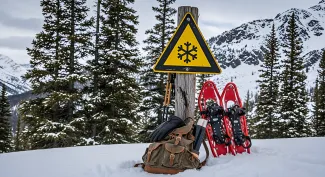
CHICAGO, United States — If you're planning to hit the backcountry slopes this winter and you fly United, you've got a problem. The airline is standing firm on its ban of avalanche airbag packs; equipment that could literally save your life in an avalanche scenario. It's the kind of policy that makes you scratch your head a bit. Here's a piece of safety gear designed specifically to keep backcountry skiers and snowboarders alive in avalanche terrain, and you can't bring it on your flight to, say, Jackson Hole or Salt Lake City. According to Airlines, United writes, "Avalanche packs that contain 1.4s and CO2 aren't allowed as checked or carry-on bags."
Why Airlines Are Banning Avalanche Airbags
The issue comes down to what's inside these packs. Most avalanche airbags work by rapidly inflating a large balloon when triggered, helping keep you on the surface of moving snow rather than getting buried. To make that happen quickly enough to matter, they use compressed gas cartridges; typically CO2 or nitrogen. Some models use pyrotechnic triggers classified as 1.4s explosives. From an airline safety perspective, I get it. Compressed gas cylinders and explosive charges aren't exactly what you want bouncing around in a cargo hold at 35,000 feet. But from a practical traveler standpoint? It's frustrating. These aren't fireworks or weapons. They're literally survival equipment.
The Broader Picture of Airline Restrictions
United isn't alone in tightening up what passengers can bring onboard, though their avalanche pack ban hits a pretty specific demographic. Airlines across the United States continue to update their prohibited items list, according to Airlines. Earlier in the year, Southwest Airlines stood alone on a "first-in-industry" charger ban, according to Airlines. Southwest Airlines has banned passengers from storing portable charging devices in bags or in overhead bins when in use, according to Airlines. The chargers must be visible when used on Southwest Airlines flights to mitigate the potential fire hazard posed by the battery, according to Airlines. Other airlines across the U.S., such as Delta Air Lines, have reaffirmed their own restrictions as battery technology evolves and new safety concerns emerge. The common thread? Airlines are increasingly focused on lithium batteries, compressed gases, and anything with even remote fire or explosion potential. It's a post-9/11 world meets modern consumer electronics meets extreme sports equipment.
What This Means for Backcountry Travelers
So what are your options if you're a serious backcountry skier or snowboarder who relies on an avalanche airbag? Well, they're not great. You could rent gear when you arrive at your destination. Many ski towns near serious backcountry terrain offer avalanche airbag rentals, though availability isn't guaranteed during peak season. You're also trusting rental equipment with your life, which isn't ideal. Some travelers are opting for electric avalanche airbags instead. These use battery-powered fans rather than compressed gas, making them theoretically more airline-friendly. But even these can run into issues depending on the battery specifications and how strictly TSA agents interpret the rules on any given day. Or you could simply skip United and check with other carriers. Airline policies on avalanche gear aren't uniform, and some are more accommodating than others; especially international carriers serving major ski destinations in Europe or Asia.
The Real-World Impact
This isn't just an inconvenience for a handful of extreme athletes. Backcountry skiing and snowboarding have exploded in popularity over the past decade. More people are venturing beyond resort boundaries, and avalanche safety education has become mainstream in the ski community. Airbag packs are now considered essential safety equipment, right alongside beacons, probes, and shovels. When airlines ban this gear, they're effectively telling a growing segment of winter travelers to either compromise their safety or find another way to fly. That's a tough position to put paying customers in, especially when you're likely marketing those same mountain destinations. The aviation industry has legitimate safety concerns to balance. No question. But as backcountry recreation becomes more popular and avalanche safety technology advances, there's got to be room for more nuanced policies. Maybe specific cartridge types could be approved. Maybe there's a way to safely package and declare this equipment similar to how firearms are transported. For now, though, if you're flying United with backcountry plans, you'll need to sort out your avalanche safety gear on the ground. It's not the answer anyone wanted, but it's the reality until the airline decides to revisit this particular prohibition.
About the Author

Bob Vidra
Bob Vidra, based in scenic Tahoe, is an esteemed tech editor known for his deep understanding of the dynamic intersection of technology, travel, and the outdoors.