
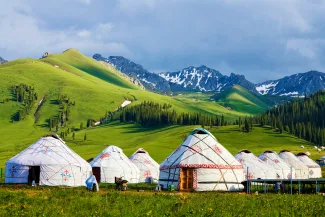
Kazakhstan Records 38% Tourism Investment Surge
NUR-SULTAN, Kazakhstan — Kazakhstan's tourism sector pulled in 923 billion tenge, roughly $2 billion, between January and October 2025, marking a 38.1% increase over the same period in 2024. The figure, announced by Minister of Tourism and Sports Yerbol Myrzabossynov during a government briefing, reflects sustained momentum in both international arrivals and domestic travel across Central Asia's largest economy. The investment spike arrives as Kazakhstan continues positioning itself as a transit and destination hub between Europe and Asia, leveraging visa liberalization, improved aviation connectivity, and infrastructure projects aimed at diversifying the economy beyond oil and gas. For travelers and expedition planners eyeing the Silk Road corridor or Central Asian overland routes, the numbers suggest improving ground conditions and growing service capacity in a region that has historically operated with lean tourism infrastructure.Foreign Arrivals Top 12 Million
Myrzabossynov reported that 12.1 million foreign nationals visited Kazakhstan for tourism purposes between January and September 2025, according to Travel. Of that total, 8.6 million were classified as tourists who stayed in the country, a distinction that separates overnight visitors from those transiting through border checkpoints or airports without meaningful engagement. The difference matters. Kazakhstan shares borders with Russia, China, Kyrgyzstan, Uzbekistan, and Turkmenistan; cross-border movement for trade, family visits, and short trips has always been high. The fact that 8.6 million visitors qualified as genuine tourists indicates a shift beyond convenience travel. More people are arriving with intention: to explore the steppe, see Almaty's mountain backdrop, visit the modernist capital, or access regional trekking and adventure routes that remain largely untapped by Western operators.What's Driving the Growth
Kazakhstan has spent the past several years systematically removing friction from inbound travel. The country introduced visa-free entry for dozens of nationalities, expanded its national carrier Air Astana's network, and invested in hotels, roads, and tourist zones around natural landmarks like Charyn Canyon and Kolsai Lakes. The government also launched promotional campaigns targeting regional travelers from Russia, China, and the Gulf states, all of whom can reach Kazakhstan with short, affordable flights. The domestic travel component is equally significant. Rising incomes and a growing middle class have pushed more Kazakhs to explore their own country rather than flying to Turkey or Dubai. That internal demand supports hotel construction, restaurant development, and tour operators who now serve both local and international clients. It's a stabilizing factor; destinations that rely solely on foreign arrivals are vulnerable to geopolitical shocks, currency swings, and external travel advisories.Investment Breakdown and Infrastructure Reality
The 923 billion tenge investment figure encompasses a broad range of projects: hotel construction, transportation upgrades, attractions, digital booking platforms, and training programs for guides and hospitality workers. While the government has not released a granular breakdown, similar investment cycles in Kazakhstan have historically favored Almaty and Nur-Sultan (formerly Astana), the two cities with the most developed tourism infrastructure and international airport capacity. Outside these hubs, conditions remain inconsistent. Roads between secondary cities can be rough, accommodations sparse, and English-language services limited. For photographers, adventure travelers, or anyone planning multi-day overland routes, this means self-sufficiency is still required. Bring offline maps, backup transportation contacts, and flexibility; the investment is flowing, but it takes time to filter through to rural guesthouses and provincial tour operators.Regional Context and Geopolitical Considerations
Kazakhstan's tourism growth unfolds against a backdrop of regional volatility. The Russia-Ukraine conflict reshaped flight routes, redirected Russian travelers southward, and increased Kazakhstan's appeal as a neutral, stable option. Simultaneously, China's loosening of COVID-era travel restrictions has reopened a massive source market just across the eastern border. The government's diversification strategy is political as much as economic. Tourism, along with tech and logistics, offers a hedge against commodity price swings and reduces dependence on hydrocarbon exports. For travelers, that means continued policy support, including potential expansion of visa-free access and streamlined customs procedures at land borders.What This Means for Travelers
The 38.1% investment increase suggests improving conditions for independent travelers and expedition groups heading into Kazakhstan's interior. Expect more mid-range hotels, better signage, expanded tour options, and a growing pool of English-speaking guides. The challenge remains finding operators who understand expedition-level logistics; many local agencies still cater to city tours and cultural programming rather than multi-day backcountry itineraries. For photographers, Kazakhstan offers steppe landscapes, Soviet-era architecture, and remote mountain ranges with minimal tourist saturation. The infrastructure improvements make access easier, but the window of relative obscurity is narrowing. As investment accelerates and arrivals climb, expect pricing to rise and popular sites to see increased congestion, particularly around Almaty and the northern lakes. The data from January through October 2025 paints a picture of a country on the upswing. Whether that momentum holds depends on continued political stability, effective infrastructure deployment, and the government's ability to market beyond regional neighbors. For now, Kazakhstan is open, accessible, and investing heavily in its tourism future.About the Author

Jeff Colhoun
Jeff Colhoun is an acclaimed travel writer, photographer, and filmmaker, whose work is respected both in the United States and internationally.