
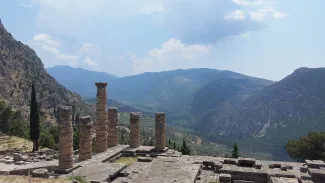
On the slopes where ancient shepherds once grazed their flocks and Byzantine hermits sought solitude, Greece is drawing new boundaries for protection. The Ministry of Environment and Energy has expanded the country's "Untrodden Mountains" program, introducing fresh safeguards across the nation's highland wilderness while simultaneously opening pathways for travelers seeking experiences beyond the well-worn trails of island beaches and archaeological sites. The announcement, delivered on December 11 to mark International Mountain Day, represents a recalibration in how Greece approaches its vertical landscapes. Known locally as Apatita Vouna, the program now extends its protective embrace to previously unguarded peaks while reinforcing measures on mountains already within the system. Among the additions is Stroggoula peak, a massif whose inclusion signals the government's commitment to preserving ecosystems that remain relatively unmarked by human activity.
The Architecture of Mountain Protection
The expansion arrives at a moment when European mountain regions face mounting pressure from both climate change and visitor numbers. Greece's highlands, long overshadowed by the magnetic pull of the Aegean and Ionian islands, have begun attracting a different caliber of traveler in recent years: those drawn to ridge walks rather than sunbeds, to stone villages clinging to mountainsides rather than whitewashed cycladic towns. The Untrodden Mountains framework operates as both shield and invitation. By designating certain areas for special protection, the program creates zones where ecological integrity takes precedence, where the slow work of forest regeneration and wildlife corridor maintenance can proceed without disruption. Yet the initiative simultaneously positions these landscapes as destinations for what Greek authorities term "alternative tourism," a model predicated on smaller numbers, deeper engagement, and minimal environmental footprint.
Beyond the Beaches
For travelers who have exhausted the conventional Greek itinerary, this expansion offers compelling possibilities. The country's mountainous spine, comprising roughly 80 percent of its landmass, contains ecosystems markedly different from the Mediterranean scrubland of the coast. Here are forests of black pine and Balkan fir, alpine meadows that erupt with wildflowers in spring, and峭壁 limestone formations sculpted by millennia of weather. Here too are brown bears in the Pindus range, wolves moving through beech forests, and raptors riding thermals above gorges that drop away into shadow. The protected designations under the Untrodden Mountains program do not close these areas to visitation. Rather, they impose frameworks that channel human presence along sustainable paths. Trails receive proper maintenance and marking. Overnight facilities, where permitted, must meet environmental standards. Local guides, many from villages that have watched populations dwindle for decades, gain opportunities to translate ancestral knowledge of the terrain into economic sustenance.
A Strategic Pivot
Greece's tourism economy, though robust, has grown increasingly concentrated. Islands such as Santorini and Mykonos absorb visitor numbers that strain infrastructure and erode the authentic character travelers ostensibly seek. The mainland mountains, by contrast, remain comparatively empty, their potential untapped. The government's mountain protection strategy represents an attempt to redirect some portion of tourist flows inland and upward, to distribute economic benefits more evenly across regions that have historically existed at the margins of prosperity. It is a delicate calibration: how to introduce travelers to fragile environments without replicating the degradation visible in over-visited coastal zones.
Practical Considerations for Mountain Travelers
Those contemplating journeys into Greece's protected mountain areas should approach with appropriate preparation. These are not landscapes to be undertaken casually. Weather patterns shift rapidly at elevation. Trails that appear manageable on maps may prove demanding in reality, particularly outside the brief summer window when conditions are most favorable. Accommodation options range from traditional mountain refuges, often operated by Greek alpine clubs, to guesthouses in villages that serve as gateways to the highlands. The infrastructure is modest compared to coastal resorts, which constitutes much of the appeal for travelers weary of packaged experiences. Spring and autumn offer optimal conditions for mountain exploration, when temperatures moderate and the summer crowds have dispersed. Winter brings snow to higher elevations, transforming certain areas into backcountry skiing terrain, though facilities remain limited compared to Alpine destinations.
The Long View
The expansion of the Untrodden Mountains program reflects a broader reckoning within Greek tourism policy. The question is whether a nation can preserve what makes it distinctive while accommodating the visitor numbers its economy requires. Mountains, by their nature, resist the kind of mass development that has remade coastlines. The topography itself imposes limits. What Greece is attempting, in effect, is to make constraint into virtue, to offer experiences predicated on access to what has remained relatively unmarked. Whether the model proves sustainable depends on implementation, on enforcement of protections, and on the willingness of travelers to accept mountains on their own terms rather than demanding they be made convenient. For now, the peaks stand as they have for millennia, their additions to the protected registry a contemporary footnote to an ancient story. The invitation to explore them comes with an implicit requirement: tread carefully.
About the Author

Wilson Montgomery
Wilson Montgomery is a British-born travel writer who has carved a niche for himself with his compelling narratives about African travel and safari experiences.