
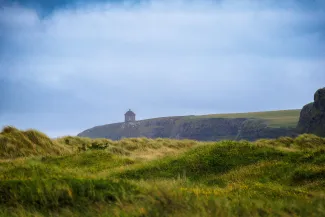
I landed in Dublin with a notebook of times, places, and check-ins. The trip was designed with precision: hikes in Wicklow, biking in the mountains, paddleboarding on a northern lake, caves, boardwalks, coastal walks, and finally the Atlantic surf. It was all there in black and white. But Ireland doesn’t live in black and white. It lives in mist and moss, in salt spray and peat smoke, in moments that unfold when you’ve stopped trying to orchestrate them.
From the start, I felt the scaffolding of the schedule, but what I remember are the spaces in between: the way the river caught light at dawn, the pause at a ruined monastery, the sound of a gong vibrating through stone. This trip had an itinerary, but it wasn’t about the plan. It was about being carried by the place itself.
A Morning on the Liffey
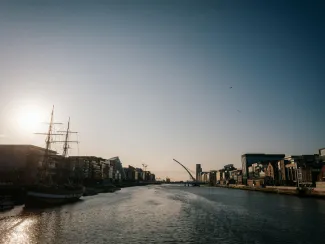
Jet lag pulled me awake before the city and I stepped outside into Dublin just as it was stirring. I followed the Liffey east, where the river slides quietly under bridges that have seen centuries of crossings. The air smelled of diesel and wet stone, but also of bread baking somewhere close. Delivery trucks rattled over cobbles, café lights clicked on, and joggers began to claim the sidewalks.
I paused often. At the Ha’Penny Bridge, its graceful ironwork reflected in the water, I leaned over the rail and watched gulls circle, their cries the first loud thing in the morning. Office lights flickered on in glass towers further down, a reminder that the workday was beginning, though it felt far away from where I stood.
It wasn’t a spectacular introduction, but it was a grounding one. That walk gave me the rhythm of the city at human scale. A reminder that the outdoors in Ireland doesn’t always mean wilderness. Sometimes it means finding your breath on a riverside before the rest of the city is awake.
Wicklow’s Pilgrim Valley
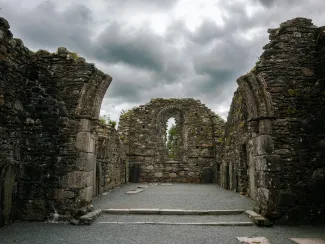
By the next morning I was in Wicklow, where Dublin’s bustle gives way to mountains that seem to exhale on your behalf. Glendalough greeted me with low clouds snagging on the ridges and the dark sheen of water stretching between them.
The Miner’s Road Walk followed the edge of the upper lake, a path cut through oak and birch. Rain the night before left the ground slick, the scent of moss rising with every step. The ruins of a monastery appeared almost casually — a stone arch here, a leaning wall there — but the weight of them was immense. St. Kevin built this settlement in the 6th century, and somehow, standing there in the damp, you can still feel the pull that drew pilgrims for centuries.
I didn’t hurry. A raven cut across the valley with a single harsh cry, and I stopped to watch it vanish into the fog. My camera hung at my side, but I barely raised it. The real gift was the stillness, the sense that this place wasn’t mine to capture, only to witness.
Pedaling Into the Hills
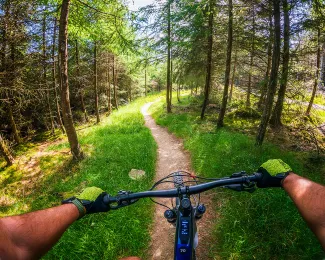
From the quiet of Glendalough I went to Ballinastoe, where speed replaced silence. An electric mountain bike hummed under me as I climbed trails cut through spruce forest, the smell of wet needles thick in the air. The rhythm of pedaling and the mechanical assist blurred until it felt like the landscape itself was carrying me uphill.
At the ridgelines the view broke open: Lough Tay, the “Guinness Lake,” a dark oval framed by pale sand, the surrounding hills rolling out toward the Irish Sea. Clouds shredded across the peaks, shadows sliding like curtains over the water.
I stopped often, not for breath but for awe. Ireland has a way of opening its views in sudden reveals, rewarding you not for reaching the summit but for being present on the way there. The riding wasn’t about adrenaline or competition; it was about falling into rhythm with the terrain. By the time I descended back into the woods, I realized I’d been smiling the entire way down.
Beneath the Earth
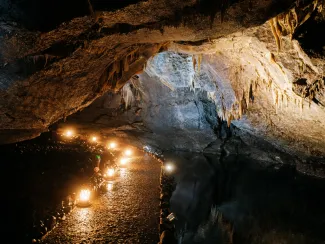
Caves test your sense of scale. At Marble Arch, I followed the Owenbrean River underground, the sound magnified until it felt like the whole cavern was breathing. Pools mirrored the ceiling in eerie perfection; formations hung above me like frozen waterfalls.
I expected geology. What I didn’t expect was music. Deep inside, I lay on a mat as a sound bath unfolded — gongs, drums, harmonic singing. The vibrations traveled through the cave walls, through the stone floor, through me. It was a sensation as physical as it was auditory.
When we resurfaced, blinking into the daylight, the colors outside felt almost unreal. The greens were too green, the sky too blue, as though Ireland had nudged the saturation just for fun.
Walking the Leaving
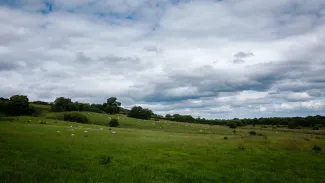
Later, on the Emigrants Trail above Carntogher Mountain, history pressed close again. A guide recounted the stories of families who had walked here during the famine, carrying everything they owned, saying goodbye to land they would never see again.
The path was short, but it carried centuries of weight. At the summit, I placed a stone on the Carn, just as they had. It wasn’t ceremonial; it was instinctual, a small act that connected me to people I would never meet but could suddenly imagine.
The landscape wasn’t just beautiful; it was storied. Every step was layered with memory, and every footfall pressed me deeper into that history.
Benone Strand
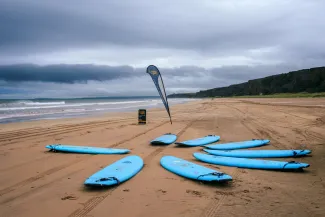
By the week’s end, the Atlantic was waiting. Benone Strand stretched seven miles, sand as clean and golden as any in the world, backed by dunes and cliffs. The horizon was pure ocean, rolling in steady lines of surf.
Pulling on a wetsuit, I carried a board into the water. The cold was a shock that stripped away thought, leaving only sensation. My first attempts were messy — short rides, long wipeouts — but soon I found rhythm. Paddle, pop, ride, fall, laugh, repeat.
Salt blurred my vision, but the smile was real. Standing for even a few seconds on a wave that had traveled across the Atlantic felt like a communion. Surfing in Ireland might sound improbable, but in that moment it felt inevitable. Mountains behind me, ocean ahead, sand underfoot — the whole country seemed to compress into that one ride.
Malahide Reflections
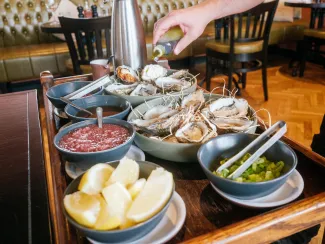
The journey closed in Malahide, a harbor town north of Dublin. Boats rocked gently in the tide, restaurants filled with conversation, and the last light turned the water to molten gold. Dinner stretched long, and as I walked back through the village, I thought about the week behind me.
I’d arrived with a plan, and I left with something better. What stayed weren’t the scheduled times or the hotel check-ins. What stayed were the pauses: the quiet walk on the Liffey, the silence of Glendalough, the vibration of a gong underground, the laughter after a wipeout in the surf.
That’s the gift of Ireland. It doesn’t just give you what you came for; it gives you what you didn’t know you needed. Some trips run on timetables. This one reminded me that the best journeys don’t. Some trips are planned. Others just take you.
About the Author

Jeff Colhoun
Jeff Colhoun is an acclaimed travel writer, photographer, and filmmaker, whose work is respected both in the United States and internationally.