
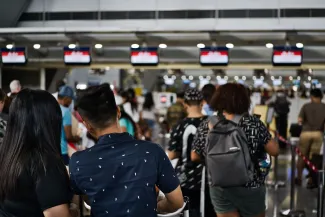
The Transportation Security Administration will introduce a new pay-on-the-spot screening option for passengers who show up for domestic flights without a Real ID-compliant driver’s license, according to a press release by the Transportation Security Administration.
What the $45 fee means at the checkpoint
Under the forthcoming rules, travelers who arrive at any TSA security lane with a standard driver’s license—or any other form of identification that does not meet Real ID security standards—will be offered a choice: present an acceptable alternative credential such as a passport, or pay a one-time, non-refundable fee of $45 for an enhanced identity verification process carried out by TSA personnel. The agency said the fee will be collected only once per trip, even if the journey involves multiple connecting flights on the same ticket. The new option takes effect February 1. One short statement in the release underscored the agency’s rationale: “The additional screening tier gives travelers flexibility while preserving rigorous security,” the TSA said.
Why TSA is adding the new option
TSA officials have long warned that domestic flyers must comply with Real ID requirements or be turned away. The legislation behind Real ID calls for stricter document authentication and anti-counterfeiting technology, all aimed at preventing identity fraud. Yet many U.S. residents still carry conventional state-issued driver’s licenses that lack the required security features. By setting a clear fee for on-the-spot vetting, TSA hopes to avoid the chaotic morning queues that can develop when passengers reach the front of the line without qualifying documents. Rather than sending such travelers back to airline counters—or worse, forcing them to rebook at a later date—the agency’s new process provides a last-minute lifeline, albeit at a cost.
How the fee-based screening will work
- At initial document check, an officer will scan the passenger’s standard license.
- If the card is flagged as non-compliant, the traveler can either:
• produce an alternate valid credential (passport, permanent resident card, military ID), or
• agree to the $45 enhanced screening. - Travelers paying the fee will be escorted to a secondary screening area, where TSA staff will conduct a series of identity confirmation steps, including live photo capture, real-time database queries and, when necessary, additional pat-downs or bag inspections.
- After completion, the passenger rejoins the general screening flow. Payment will be accepted via credit card, mobile wallet or select contactless platforms. Cash will not be accepted to streamline throughput and avoid handling delays. A digital receipt will automatically be sent to an email address or mobile number supplied by the traveler.
Implications for airlines and airports
Airport operators and airline station managers have been briefed on the new policy, giving them several weeks to update signage and passenger-notification systems before the February 1 rollout. Ticket counter agents are also expected to remind customers of the looming change when checking bags. Some airports are exploring dedicated service kiosks near the checkpoint where travelers can quickly self-assess the compliance status of their licenses before joining the queue.
Tips for travelers: avoid the fee altogether
- Check your driver’s license: Look for the star emblem or other state-specific Real ID marking on the front. If it is present, you are compliant and owe nothing.
- Carry a backup credential: Passports, passport cards, Global Entry cards and U.S. military IDs already meet federal requirements. Having one in your wallet eliminates the risk of last-minute charges.
- Upgrade early at the DMV: Most state motor-vehicle agencies let you convert to a Real ID by bringing proof of citizenship or lawful status, plus residency documents. Expect to apply in person.
- Leave extra time for morning departures: The early-hour rush is where ID issues most often snarl checkpoints. Arrive earlier than usual if you even suspect your license may not pass muster.
- Keep digital copies separate: Snap a secure, encrypted photo of your passport and store it in a trusted travel-wallet app. While a digital copy will not replace the physical ID at TSA, it can speed up re-issuance later if you misplace the original.
Frequently asked questions
Does the $45 payment guarantee that I will still make my flight? Not necessarily. The enhanced screening lane is designed to be efficient, but TSA states that standard “allow ample time” advice still applies. Travelers remain responsible for reaching their gate before boarding closes.
Is the $45 fee a one-time charge or per segment? The press release specifies the fee is assessed only once per trip itinerary, meaning a passenger changing planes will not pay again at a connecting airport.
Will I get a temporary Real ID credential after paying? No. The screening fee covers identity verification for that day’s travel only; it does not substitute for obtaining a compliant license through your state DMV.
Can children travel without paying? Children under the age requirement to present identification when flying domestically with an adult will not be charged. [Not specified in release] if minors traveling alone fall under the same exemption.
The road ahead for Real ID enforcement
Although TSA’s press release offers the new fee as a short-term convenience, the agency continues to urge every eligible traveler to upgrade their license well in advance of any future enforcement deadlines. The press release reiterates that the fee is “not intended as a permanent workaround” but rather as a buffer that protects both operational efficiency and travel plans during the transition period. For frequent flyers, the real takeaway is simple: upgrade now or carry an acceptable alternative. Otherwise, that spontaneous weekend getaway may start with an unwelcome $45 surprise.
— Source: Transportation Security Administration press release
About the Author

Bob Vidra
Bob Vidra, based in scenic Tahoe, is an esteemed tech editor known for his deep understanding of the dynamic intersection of technology, travel, and the outdoors.