
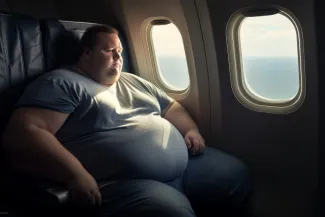
Flying used to be glamorous. Champagne in crystal glasses, legroom for a Labrador. Now it’s more like paying $600 for a middle-school bus ride, except the kid in your seat is a full-grown adult and their torso has staged a hostile takeover of your personal space.
This isn’t about shaming—it’s about physics. Airline seats are shrinking, waistlines are expanding, and geometry has no mercy.
Airline Roulette: Policies on “Passengers of Size”
“You’ll find out mid-flight whether your neighbor qualifies. It’s like buying a lottery ticket where the jackpot is simply breathing freely.”
Southwest Airlines – If you can’t comfortably lower both armrests, you’re supposed to buy an extra seat. They’ll refund you if the flight isn’t full. Bless their hearts—they’ve turned armrests into measuring sticks.
United & Delta – Vague language about fitting “safely and comfortably.” Translation: you’ll know when your seatmate’s shoulder is using your tray table.
Spirit & Frontier – Their policy is essentially: “If you’re suffering, you must be alive. Welcome aboard.” Seats so narrow that average passengers qualify as oversize by snack time.
War Stories From the Aisle
Every frequent flier has them.
The transatlantic passenger whose seatmate’s torso spilled over like rising sourdough.
The woman wedged between two linebackers, arms locked T-rex style, unable to reach her water bottle for seven hours.
The guy who realized mid-flight that his lap had become someone else’s overflow storage.
Empathy is important. But so is oxygen.
The Etiquette of Seat Spillage
Most of us default to martyrdom. We fold ourselves into shapes Cirque du Soleil would admire and mutter, “I’ll survive. Probably.”
Speaking up is awkward. You can’t exactly lean over and say:
“Excuse me, you’re currently occupying 30% of my skeletal system.”
And flight attendants? They’ll either move you (punishing the innocent) or give you that apologetic smile that means, “Sir, this is Spirit Airlines. You’re lucky we even have wings.”
The Real Culprit: Shrinking Seats
The cruel irony: people have gotten bigger while seats have gotten smaller.
1990s: 18.5 inches wide
Today: ~17 inches wide
That’s narrower than a high school desk chair. Legroom has shrunk too, leaving anyone taller than a garden gnome already in crisis.
It’s not a mystery why people spill over—it’s math.
Possible Solutions (Nobody Likes Them)
Wider seats across the board. Nice idea. But airlines would have to cut rows, and fares would skyrocket. Imagine $1,200 for a three-hour hop to Denver.
Strict two-seat rule. Fair in theory, but no airline wants to play villain.
Comfort Class. Seats a little wider than coach, not as plush as business. Airlines would still slap fees on “armrest access” and “complimentary lap space.”
Or—and I know this is radical—if you know you’ll need two seats, buy two. After all, you don’t bring three toddlers to the movies and expect them to share a single chair.
Sidebar: Airline Policies at a Glance
| Airline | Policy Summary | Customer Experience |
|---|---|---|
| Southwest | Buy an extra seat if you can’t fit; refund if flight isn’t full. | Transparent, awkward at check-in. |
| United/Delta | Must fit “comfortably.” | Roulette wheel. |
| Spirit/Frontier | No clear policy, just suffering. | You bought a ticket; that’s all you get. |
Oversize passengers aren’t villains. Nobody wants to sit on top of their neighbor. But when you buy a ticket, you’re buying the promise of a seat—not half a seat, not a shared seat, a whole seat.
Until airlines come up with a better system than “suffer in silence,” we’ll keep praying to the seat assignment gods for the ultimate jackpot: an empty middle seat.
And when that blessed miracle happens? We’ll spread out, sigh deeply, and—for one glorious moment—remember why flying almost used to feel worth it.