
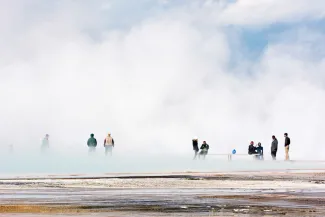
YELLOWSTONE NATIONAL PARK, Wyo. — A viral video of a sightseer lifting cupped hands to his lips at a steaming thermal pool has reignited safety concerns just as Yellowstone National Park braces for another record-setting summer. The clip, first shared this week from Mammoth Hot Springs, underscores a growing tension between surging crowds and the fragile, sometimes deadly, hydrothermal landscape that makes Yellowstone famous.
Visitor numbers close to an all-time high
Yellowstone welcomed 928,250 people in June 2025, only 1 percent shy of the 937,000 tally that set a monthly record in 2021. At the current pace, park officials project annual visitation could finish the year about 4 percent above the previous high. The pressure is already apparent at the five entrance stations, where lines of cars have been forming as early as 9 a.m. For travelers, that means strategizing arrival times. Rangers advise entering either before dawn or after mid-afternoon to avoid the thickest bottlenecks, especially at the West Yellowstone and South Entrance gates. Patience, they note, is essential when you share roads with nearly a million fellow explorers during a single month.
Why sipping a hot spring can be lethal
The man in this week’s video is hardly the first to ignore warnings. More than 20 people have died from burns after walking or falling into hot springs, park records show. Yet drinking directly from a pool adds an invisible hazard: toxic chemistry. In a statement, the U.S. Geological Survey said, “Thermal water should not be used as drinking water.” The agency lists multiple reasons:
- Arsenic levels in some Yellowstone hot springs reach 1 mg/L and have spiked as high as 17 mg/L—about 2,000 times the U.S. Environmental Protection Agency’s maximum contaminant level of 0.010 mg/L for drinking water.
- Fluoride concentrations can soar to 57 mg/L, far above the 4.0 mg/L limit set by the EPA.
- Pathogens such as Naegleria, a brain-eating amoeba, thrive in warm water and can be fatal if inhaled or consumed.
- Additional contaminants, including antimony and mercury, complicate the chemical cocktail.
Even non-thermal creeks and rivers require treatment before anyone should refill a bottle; parasites and E. coli are common in the backcountry. Travelers relying on surface water need filters capable of removing bacteria, protozoa and, ideally, viruses.
Social media fuels “touron” trend
The Instagram account TouronsOfYellowstone—known for spotlighting rule-breakers—shared the latest footage with the caption, “Did that guy just taste the thermal water⁉️,” the account wrote on Instagram. Within hours, commenters piled on with gallows humor, predicting the drinker would soon create his own “mud pot.” While the remarks are tongue-in-cheek, rangers say the underlying behavior drains staff resources. Every time a visitor steps off a boardwalk or approaches wildlife, another team member must pivot from interpretive work to crowd control or emergency response.
Know the rules before you go
The National Park Service (NPS) posts large, often bilingual signs at major geyser basins. Yet violations persist. For first-time and returning guests alike, here are the principal dos and don’ts in the park’s hydrothermal areas:
- Walk only on boardwalks or designated trails. The thin sinter crust can break like ice over scalding water.
- Keep children within arm’s reach; running or horseplay on slick planks is dangerous.
- Never touch runoff or throw objects into pools. Besides damage to the formations, toxic gases can accumulate nearby.
- Swimming or soaking in hot springs is prohibited; temperatures often exceed 199 °F.
- Pets are banned in thermal zones.
- If you feel dizzy or nauseated, move upwind immediately. Hydrogen sulfide buildup can occur on calm days.
Timing your visit around crowds and safety patrolling
Park spokespersons confirm that busiest hours tend to cluster between 10 a.m. and 3 p.m. at sites such as Old Faithful, Grand Prismatic Spring and Norris Geyser Basin. Earlier or later arrivals not only reduce traffic stress but also allow cooler temperatures for long walks on elevated pathways. During prime summer weeks, additional rangers and volunteer “roving stewards” patrol popular boardwalks. They carry infrared thermometers to measure pool edge temperatures and portable radios to call in medical assistance. According to the NPS, the response time to an off-boardwalk injury can exceed 30 minutes because teams must secure their own footing before reaching a victim.
Tips for Travelers
- Pack water. Bring at least one liter per person for a half-day excursion; do not plan to refill from features.
- Carry filtration gear. For backcountry trips, use a filter plus chemical treatment to remove heavy metals and microorganisms.
- Stay informed. Pick up the free park newspaper at entrance stations; it lists temporary area closures and wildlife advisories.
- Mind parking. Lots at Midway Geyser Basin and Fairy Falls Trail often fill before 8 a.m. Consider using overflow areas and walking an extra half-mile.
- Respect wildlife distances. Remain 25 yards from bison, elk and deer; 100 yards from bears and wolves.
Looking ahead: balancing access with preservation
Yellowstone administrators have not signaled an immediate switch to timed entries, but the sustained growth—928,250 visitors in one month alone—keeps the idea on the table. For now, the park relies on information campaigns, social media monitoring and fines that can climb to several hundred dollars for leaving boardwalks. Officials remind travelers that hydrothermal features are irreplaceable. When humans toss coins, rocks or—rarely—sip the scalding water, they jeopardize both personal health and a delicate environment that took millennia to form. As the summer peak approaches, seasoned parkgoers say the formula for safe enjoyment remains straightforward: arrive early, stay on path, carry your own potable water and let the geysers do the bubbling. — as the USGS and park officials emphasized in recent advisories.
About the Author

Wilson Montgomery
Wilson Montgomery is a British-born travel writer who has carved a niche for himself with his compelling narratives about African travel and safari experiences.